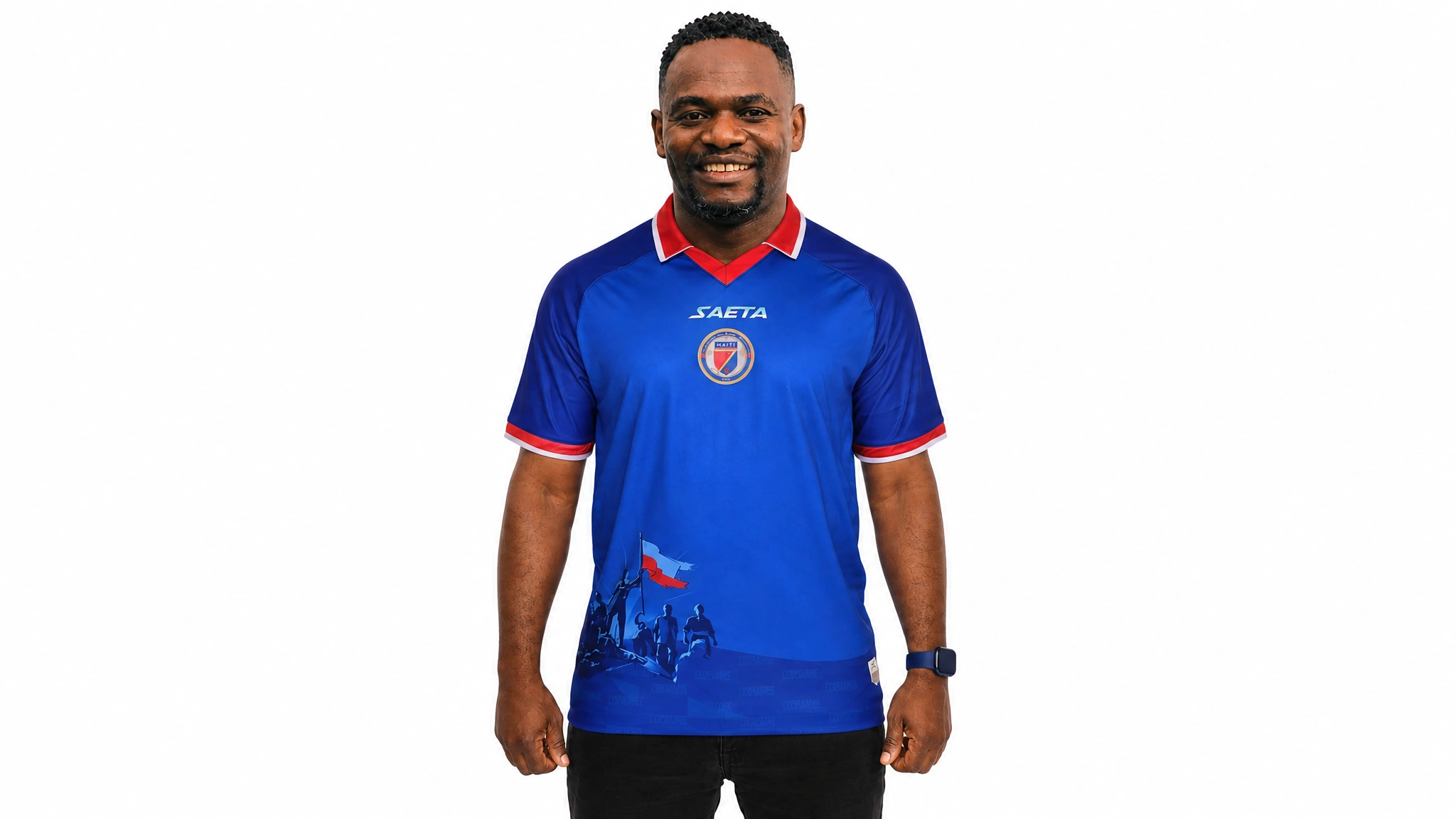
FIFA Says Haiti’s History Is “Political.” As a Haitian, I Find That Deeply Troubling.
When I heard that FIFA rejected Haiti’s original World Cup jersey because it was considered “political,” I felt disappointed, but not surprised.
As Haitians, we are used to seeing our history misunderstood, ignored, or reduced to controversy. But this time, it hurts differently because it comes at a moment when our nation should simply be celebrating.
For the first time in more than fifty years, Haiti is returning to the World Cup. In a country that has endured political instability, natural disasters, economic hardship, and countless challenges, this should be a moment of pride. A moment where Haitians everywhere can stand together and say, “Nou la toujou”—we are still here.
Instead, we are being told that a symbol honoring our history is too political to appear on a football jersey.
Let that sink in.
The Battle of Vertières is not a political party. It is not an election campaign. It is not propaganda. It is the battle that led to Haiti’s independence. It is part of the reason Haiti exists at all.
If Haitians cannot honor Vertières, what exactly are we allowed to celebrate?
As a Haitian, I don’t see Vertières as politics. I see sacrifice. I see courage. I see men and women who refused to accept slavery as their destiny. I see ancestors who paid the ultimate price so that future generations could live free.
That is not politics.
That is identity.
That is heritage.
That is history.
What troubles me most is the inconsistency. Every nation celebrates the events that shaped its existence. Countries honor wars of independence, national heroes, revolutions, and defining moments of their past. Yet when Haiti chooses to honor the greatest moment in its history, suddenly it becomes controversial.
Why?
Why is Haiti’s fight for freedom considered political, while other nations’ historical achievements are considered patriotic?
These are difficult questions, but they deserve to be asked.
The truth is that Haiti’s story has always made some people uncomfortable. We were the first Black republic. We were the first nation born from a successful slave revolution. We defeated one of the most powerful colonial systems in the world.
Our history is powerful because it reminds the world that people who were considered powerless changed the course of human history.
Perhaps that is why it continues to make some people uneasy.
But whether FIFA approves of it or not, Vertières belongs to us.
It belongs to every Haitian child learning about Dessalines, Capois-La-Mort, Christophe, and the heroes who fought for our freedom.
It belongs to every Haitian living in Port-au-Prince, Cap-Haïtien, Jacmel, Gonaïves, Miami, Montreal, Paris, New York, Minnesota, or anywhere else in the diaspora.
It belongs to all of us.
A jersey is more than fabric. It tells a story. It represents a people. It carries a legacy.
And if the story of Haiti’s freedom is considered too political to wear on a football field, then perhaps the problem is not the story itself.
Perhaps the problem is that more than 220 years later, the world is still uncomfortable with what that story represents.
As a Haitian, I will never apologize for honoring Vertières.
I will never apologize for remembering those who fought for our freedom.
And I will never accept that celebrating Haiti’s birth is somehow a political act.
It is not politics.
It is who we are.
Comments are closed