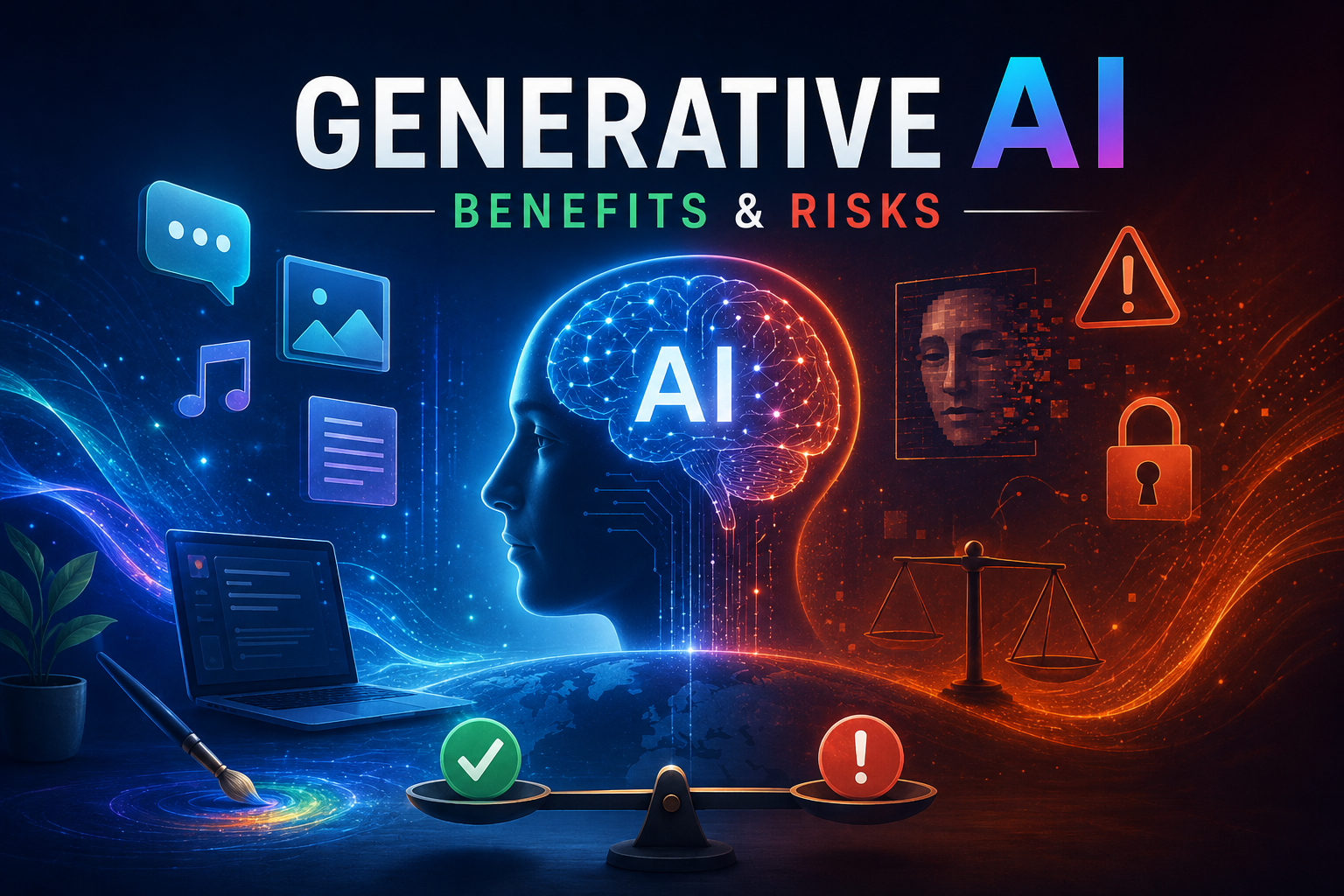
What Is Generative AI?
Generative AI is a type of artificial intelligence designed to create new content rather than simply analyze existing information. It can generate text, images, music, videos, computer code, and other forms of media by learning patterns from massive datasets.
Unlike traditional software that follows strict programmed rules, generative AI learns from examples. For instance, a generative AI model trained on millions of books and articles can produce human-like writing, while an image-generation model trained on photographs and artwork can create entirely new images from text descriptions.
Popular examples of generative AI include AI chatbots, image generators, music creation tools, and video generation systems. These technologies are powered by advanced machine learning models, especially deep learning and neural networks.
Generative AI works by predicting patterns. In text generation, the system predicts which words are most likely to come next based on the data it learned from. In image generation, it predicts visual patterns and shapes to create entirely new pictures.
Advantages of Generative AI
One of the biggest advantages of generative AI is speed and efficiency. Tasks that once took hours or days can now be completed in minutes. Writers can draft articles faster, designers can generate concepts quickly, and programmers can receive coding assistance almost instantly.
Generative AI also improves accessibility. People without advanced technical or artistic skills can create content using simple instructions. Small businesses and individuals now have access to tools that were previously expensive or required specialized expertise.
Another advantage is creativity support. AI can help brainstorm ideas, suggest designs, create prototypes, or assist with problem-solving. Many professionals use generative AI as a collaborative tool rather than a replacement for human creativity.
Businesses also benefit from automation and productivity gains. Customer service, marketing, education, research, and software development can all become more efficient with AI assistance.
In healthcare and science, generative AI may help researchers analyze data, simulate molecules, assist with medical documentation, and accelerate discoveries.
Disadvantages of Generative AI
Despite its benefits, generative AI also introduces serious concerns.
One major issue is misinformation. AI systems can generate false or misleading content that appears realistic. Fake news articles, deepfake videos, and fabricated images can spread quickly online and become difficult to identify.
Another concern is accuracy. Generative AI does not truly “understand” information the way humans do. It predicts patterns based on training data, which means it can sometimes generate incorrect answers, invented facts, or misleading explanations.
Privacy and copyright concerns are also significant. Many AI systems are trained using large amounts of internet data, which may include copyrighted material, personal information, or sensitive content.
Job displacement is another widely discussed issue. As AI becomes more capable, some repetitive or content-based jobs may become partially automated. Industries involving writing, customer service, design, and data processing could experience major changes.
Bias is also a challenge. AI systems can inherit biases from the data they are trained on, potentially producing unfair or discriminatory results.
There are also cybersecurity risks. Generative AI can be misused to create phishing emails, scams, fake identities, malicious code, or realistic impersonations.
Finally, heavy reliance on AI may reduce critical thinking and human creativity if people become too dependent on automated systems.
Other Types of AI Besides Generative AI
Generative AI is only one branch of artificial intelligence. There are many other types of AI systems designed for different purposes.
Reactive AI
Reactive AI is the most basic type. These systems respond to specific inputs but do not remember past experiences. They follow fixed rules and cannot learn over time.
An early example was IBM Deep Blue, the chess computer that defeated world chess champion Garry Kasparov in 1997.
Machine Learning AI
Machine learning AI focuses on identifying patterns in data and improving performance through experience. Instead of being manually programmed for every task, the system learns from examples.
Machine learning powers:
- Recommendation systems
- Fraud detection
- Spam filters
- Predictive analytics
- Voice recognition
Deep Learning AI
Deep learning is a more advanced form of machine learning that uses neural networks inspired by the human brain. These systems can process enormous amounts of data and are especially effective for speech recognition, image analysis, and language processing.
Deep learning is the foundation behind many modern AI breakthroughs.
Natural Language Processing (NLP)
Natural Language Processing focuses on helping computers understand and generate human language.
NLP powers:
- Translation tools
- Chatbots
- Voice assistants
- Speech-to-text systems
- Sentiment analysis
Computer Vision AI
Computer vision enables machines to interpret and analyze visual information from images or videos.
Applications include:
- Facial recognition
- Medical imaging
- Self-driving vehicles
- Security systems
- Manufacturing inspection
Expert Systems
Expert systems are AI programs designed to mimic human experts in specific fields. They use large sets of rules and specialized knowledge to make decisions or recommendations.
These systems were popular in early AI development and are still used in areas like diagnostics and technical troubleshooting.
Robotics AI
Robotics AI combines artificial intelligence with physical machines. Robots can use AI to navigate environments, recognize objects, and perform tasks autonomously.
Examples include:
- Warehouse robots
- Surgical robots
- Industrial automation
- Delivery robots
Autonomous AI
Autonomous AI systems can make decisions and act independently with minimal human input.
Examples include:
- Self-driving vehicle systems
- Drone navigation
- Automated industrial systems
Conclusion
Generative AI is one of the most powerful and rapidly growing forms of artificial intelligence. It allows machines to create content that resembles human work, transforming industries such as education, entertainment, healthcare, and software development.
However, generative AI also brings risks involving misinformation, privacy, security, and job disruption. Understanding both its strengths and weaknesses is important as AI becomes increasingly integrated into society.
At the same time, generative AI is only one part of the larger AI landscape. Other forms of AI — including machine learning, computer vision, robotics, and expert systems — continue to shape the modern world in different ways. Together, these technologies are redefining how humans interact with computers and how technology influences everyday life.
Comments are closed